

Urban League’s 108th Annual Dinner Honored Survival, Service and a Shared Path Ahead
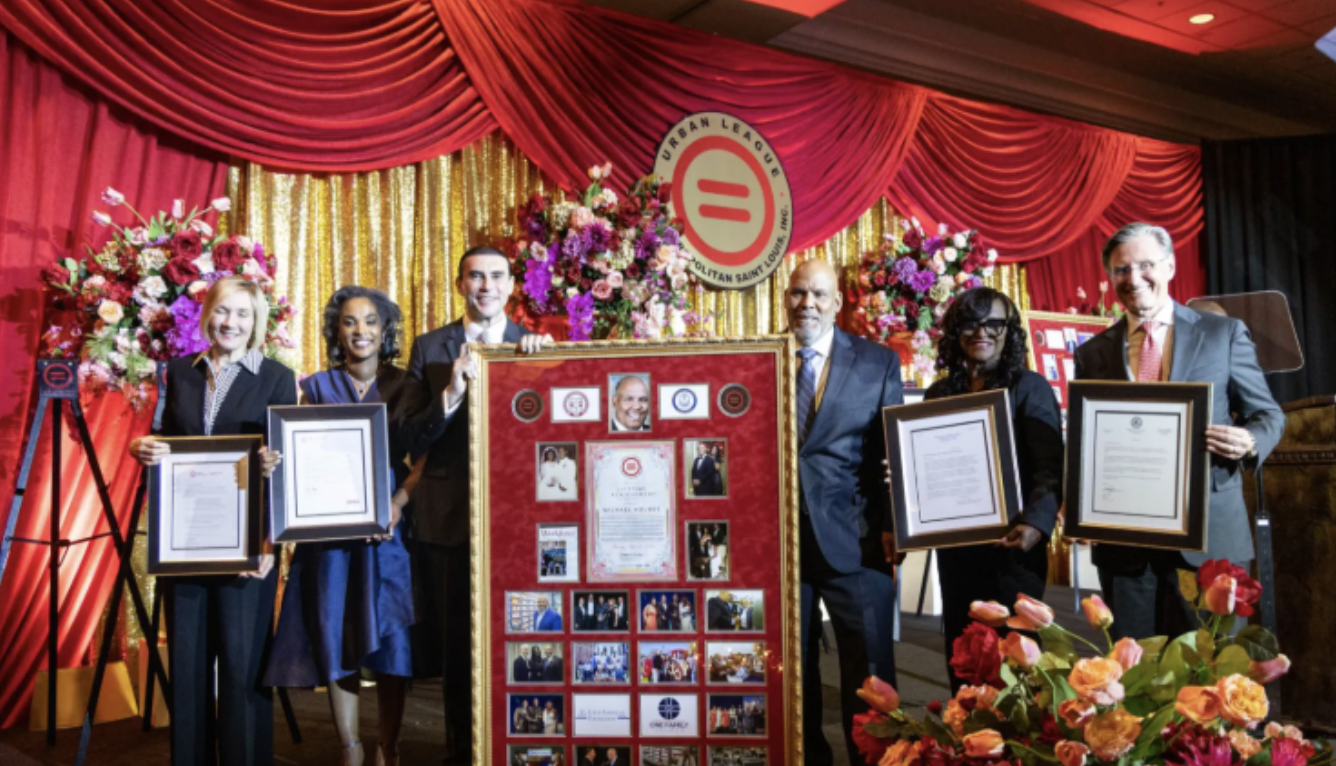
Inside the St. Louis Marriott Grand on Thursday, April 30, the applause rose like a long, overdue exhale. It was the kind of release that comes from a room full of people who have lived through something together. Nearly a year has passed since May 16, 2025, when an EF3 tornado tore through North St. Louis. And on this night, at the Urban League of Metropolitan St. Louis’ (St. Louis, MO) 108th Annual Dinner, the community gathered to honor what was lost, what was rebuilt, and what still lies ahead.
For thousands of families, the storm’s path was more than physical. It cut through routines, stability, and the illusion that tomorrow would look like today.
“You start your morning off normal and happy… and afterwards, you come home to a disaster,” said Angela Meeks, recalling the moment her world shifted in the Urban League’s 2025 recap video that was part of the dinner’s program. She couldn’t even reach her block. Two streets away, she parked and walked into what felt like a movie set — neighbors stunned, homes split open, futures suddenly uncertain.
“If you don’t have a roof, you don’t have a home,” she said. “And the Urban League got us back to where we had a roof over our head.”
They repaired her home. They helped furnish it. They helped her breathe again.
The devastation didn’t spare the Urban League itself.
“At our business center on Natural Bridge, one of the HVAC systems fell on top of our staff member’s car,” said Urban League President and CEO Michael P. McMillan. “Had she been in it, she would have died.”
But retreat was never an option.
“What happened next defined who we are,” said longtime broadcaster Carol Daniel, who serves as director of the Urban League’s Save Our Sisters program, in a video presentation that anchored the evening. “We became a lifeline.”
The Urban League became a source of sustenance. They supported more than 30,000 people through weekly disaster-relief drives. They invested over $3 million to assist more than 40,000 residents who were directly impacted. They placed 750 families in hotels and showed up for 15 consecutive weeks of large-scale Saturday distributions, which provided more than one million pounds of food valued at $2.7 million to households across North St. Louis.
They didn’t just show up once. They stayed.
Standing before a nearly full ballroom, McMillan framed the organization’s response not as extraordinary, but essential.
“Even in the face of challenges… we did not pause our mission,” he said. “When the work was hardest, we expanded it.”
That expansion now reaches 225,000 people annually through more than 60 programs: from workforce development and housing stability to early childhood education, senior services, and bridging the digital divide.
To read the full story, click here.