

Op-Ed: The Corporate Playbook Bleeding America
Written By:
Samina Radia | Affiliate Services Summer Advisor
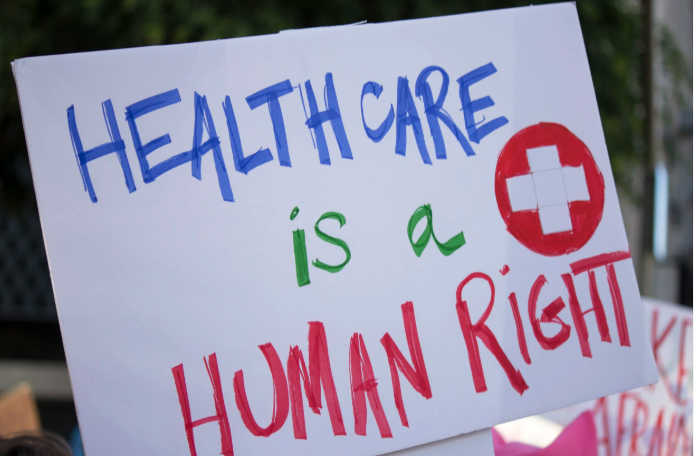
The United States is one of the wealthiest nations in the world, yet our $5.3 trillion (about $16,000 per person in the US) healthcare expenditures do not guarantee Americans universal healthcare due to systemic underlying issues. According to the National Health Expenditure Accounts, domestic healthcare cost 18% of our nation’s total economic output in 2024 (Centers for Medicare & Medicaid Services [CMS], 2026). But these trillions do not buy wellness for our communities; they buy bureaucracy. This quantitative data only reveals our grim reality: our healthcare system has been weaponized against the very people it is meant to serve. To Defend Democracy, Defeat Poverty, and Demand Diversity, we must dismantle the insidious corporate strategy that dictates modern insurance: Delay, Deny, Defend.
According to Rutgers Law professor Jay M. Feinman (2010), the strategy of “delay, deny, defend” is rooted when a “company delays payment of a claim, denies all or part of a valid claim, or aggressively defends litigation the policyholder is forced to bring to get what he is rightfully owed” (p. 12). This strategy has simply caused deaths. Take Eric Tennant, for example: he was diagnosed in 2023 with a rare cancer. However, his oncologist believed he was a suitable candidate for a new, noninvasive procedure called histotripsy, only to be denied by his health insurer who believed it was “not medically necessary.” He passed away two years later, still fighting his insurer, though the insurer reversed the decision too late after media pressure (Sausser, 2026).
Stories like Tennant’s expose a profound breach of our social contract. How did we allow a society to evolve where corporate actors without medical degrees hold life-altering veto power over patients? Unlike dedicated physicians, these corporate executives have never taken a Hippocratic oath to honor humanity, and to "Do No Harm." The philosopher Jean-Jacques Rousseau argued that human beings naturally possess pitié, an innate compassion for others. Yet, as the corporate playbook has consumed American medicine, this fundamental empathy has depleted, leaving profit margins to dictate the boundaries of human survival. It is necessary to demand democracy, and to advocate for more health professionals to make decisions for patients’ health, not corporate actors.
Defeating poverty is necessary for all our communities because the American population faces a tiered system where quality of care is determined by a patient’s socioeconomic status. Whilst the nation’s budget grows, exorbitant healthcare costs fail to accommodate low-income neighborhoods, leading to untreated health issues among vulnerable populations. Medicaid was intended to assist these populations, yet the program suffers structural setbacks that prevent it from providing adequate care. Sourced through a joint effort of the federal and state governments, Medicaid allows low-income individuals to pay little to no cost for treatment. However, since states control how much aid they provide, one might qualify for life-saving treatment in New York but be denied the same care in a state that has not expanded Medicaid requirements. This creates inequality, as a citizen’s aid depends entirely on geographical location rather than medical needs. This reality directly conflicts with the U.S. Department of Health and Human Services’ [HHS] (2022) stated goals to streamline coverage rules across state lines.
Furthermore, because Medicaid is heavily focused on income status, citizens face significant drawbacks when forced to “re-prove” their poverty every few months. This system incentivizes individuals to suppress their earnings to avoid exceeding the qualifying threshold; missing a single piece of correspondence or experiencing a minor income fluctuation can lead to a total loss of coverage. The long-term effects of this instability lead to untreated health issues, as patients cannot maintain relationships with doctors when their insurance is dependent on income. The idea of denial being associated with poverty is deeply intertwined. As Marc H. Morial mentions, “For a nation with a $23 trillion economy... to have double digit levels of poverty and even more people living on the brink, is unacceptable” (Monteil, 2026). Thus, to defeat poverty, government officials should address the issues associated with Medicaid, a program that was designed to help patients rather than work against them.
Demanding diversity is crucial in healthcare because insurance models would defend less quality treatment. As noted by Bittker (2020) in a publication for the American Bar Association [ABA], “Poor health, obesity, and mortality rate directly correlate to insurance status. Access to good health care for all would reduce instances of chronic and acute illness and infirmity in underinsured communities.” In other words, the ABA notes that despite having substantial negotiating leverage with insurance companies, Black Americans are 10% less likely than their white counterparts to get employer-sponsored health coverage, even when working for organizations with 500 or more employees (Bittker, 2020). Furthermore, in anticipation of future expenditures, these underinsured individuals may decide on short-term treatment choices that need fewer follow-up visits, put off seeing doctors, or forego medical care entirely. Diversity is necessary to improve the healthcare reality of many, and it serves as a fundamental core in improving the quality of treatment for all.
If we really want to tackle inequality in our society, equity has to be our starting point. As the National Urban League puts it: “Defend Democracy, Demand Diversity, and Defeat Poverty.”
--
APA References:
Bittker, B. M. (2020, September 7). Racial and Ethnic Disparities in Employer-Sponsored Health Coverage. Human Rights. https://www.americanbar.org/groups/crsj/resources/human-rights/archive/racial-ethnic-disparities-employer-sponsored-health-coverage/
Centers for Medicare & Medicaid Services. (2026, June 24). NHE fact sheet. https://www.cms.gov/data-research/statistics-trends-and-reports/national-health-expenditure-data/nhe-fact-sheet
Feinman, J. M. (2010). Delay, Deny, Defend: Why insurance companies don’t pay claims and what you can do about it. https://ia801704.us.archive.org/4/items/delaydenydefend/delaydenydefend.pdf
Monteil, C. (2026, July 10). Empowerment 2.0 focuses on three Ds: Defend democracy, demand diversity, defeat poverty. National Urban League. https://nul.org/news/empowerment-20-focuses-three-ds-defend-democracy-demand-diversity-defeat-poverty
Sausser, L. (2026, March 31). After man’s death following insurance denials, West Virginia tackles prior authorization. NBC News. https://www.nbcnews.com/health/health-news/mans-death-insurance-denials-west-virginia-tackles-prior-authorization-rcna265540
U.S. Department of Health and Human Services. (2022, December 8). What’s the difference between Medicare and Medicaid? https://www.hhs.gov/answers/medicare-and-medicaid/what-is-the-difference-between-medicare-medicaid/index.html