

Black and Latino Civil Rights Leaders Urge Unity in L.A. Town Hall
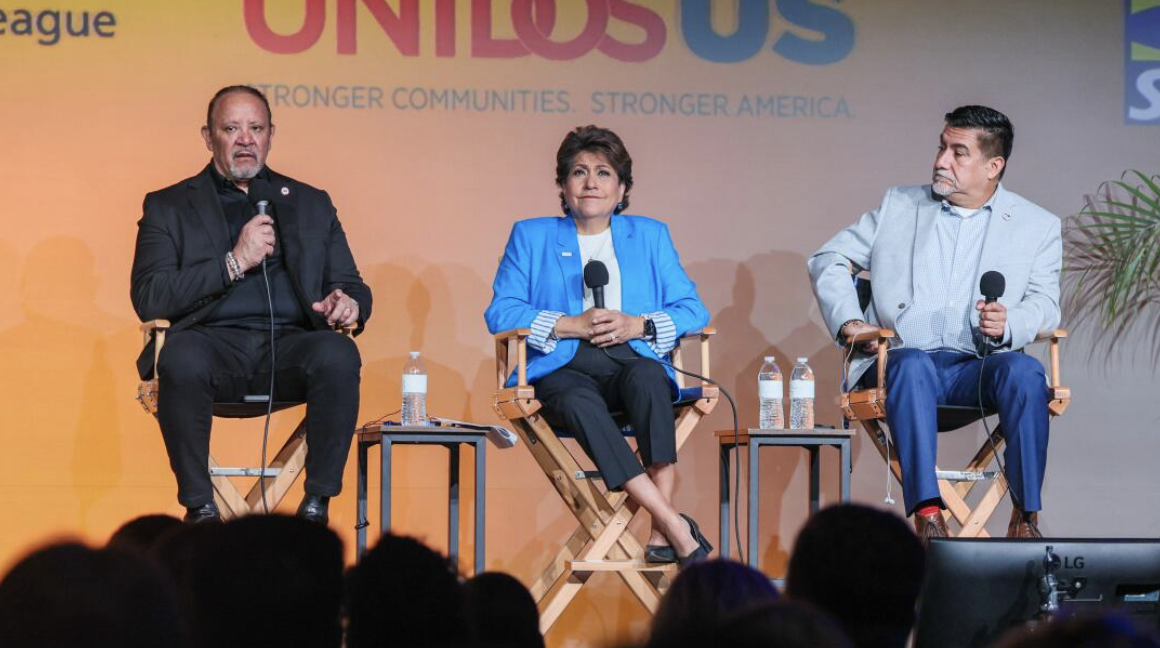
Leaders from prominent civil rights organizations and labor unions gathered with L.A. community members to discuss the economic and political issues being faced by Black and Latino communities in the U.S. — many of whom remain overworked, underpaid and under-protected.
The main speakers at the event were Janet Murguía, president and CEO of the Latino civil rights advocacy group UnidosUS; Marc H. Morial, former New Orleans mayor and current president and CEO of the Black civil rights organization National Urban League; and David Huerta, the president of the California service workers unions SEIU-USWW and SEIU California.
The trio spoke largely to a crowd of Latino and Black SEIU union workers — who donned T-shirts emblazoned with slogans calling for respect, safety and fair pay for service workers — and National Urban League members.
Attendees chanted “Si se puede” and “When we fight, we win,” which originated from Dolores Huerta. Celebratory olé-style songs also broke out among the attendees, as they sipped on café de olla and snacked on pan dulce.
Here are some key takeaways from Thursday’s town hall:
Division is coming from above
All three speakers talked about how, in spite of many shared struggles within the Black and Latino communities, there remains a wedge between the two — which has been exacerbated by the political leaders in the U.S.
“They are creating and taking advantage of any tensions that might already exist that we have all been working to bridge over the decades-long histories of our organizations and our goals,” said Morial. “But there’s more that unites us than divides us, and [we] are aligned on that positive vision of an inclusive America that will allow everyone to prosper.”
Murguía pointed specifically at the Trump administration’s rhetoric as a key roadblock in bridging the gap in Black and Latino relations.
“In President Trump we have someone who has been quite intentional about exploiting differences,” she said. “Folks are getting messages [that] create this sense that we’re competing, that we should be afraid of each other and that the pie is going to be too small for everyone.”
Community leaders must model allyship to bridge gaps
Morial spoke of how leaders must lead by example in crafting and strengthening a Black-Latino coalition.
When UnidosUS and National Urban League first began working together over 20 years ago, there was “no discernible” relationship among Black and Latino civil rights organizations. Together, the groups rallied behind their collective support for the re-authorization of the Voting Rights Act in 2006 and have been linking up ever since.
“It’s not going to happen with one meeting. It’s not going to happen with one gesture. It’s not going to happen with performative politics,” Morial said. “It’s only going to happen when community leaders at the local level build dialogue and find things to agree on.”
Community leaders must model allyship to bridge gaps
Morial spoke of how leaders must lead by example in crafting and strengthening a Black-Latino coalition.
When UnidosUS and National Urban League first began working together over 20 years ago, there was “no discernible” relationship among Black and Latino civil rights organizations. Together, the groups rallied behind their collective support for the re-authorization of the Voting Rights Act in 2006 and have been linking up ever since.
“It’s not going to happen with one meeting. It’s not going to happen with one gesture. It’s not going to happen with performative politics,” Morial said. “It’s only going to happen when community leaders at the local level build dialogue and find things to agree on.”
To read the full story, click here.