

Inside Harlem's New Urban Civil Rights Museum
November 16, 2026 - “Civil rights is not a closed chapter, it’s an ongoing story,” asserted Jennifer Scott, executive director and chief curator of the Urban Civil Rights Museum (UCRM).
This new museum, established by the National Urban League (New York, NY), officially opened on November 14 in Harlem at its 125th Street headquarters. There has never been a civil rights museum in New York City, let alone New York State, so it is a unique contribution to the region’s cultural landscape. The UCRM is the culmination of an idea that began over a decade ago to create a permanent space that speaks to the northern civil rights experience and the northern Black experience. It intentionally begins telling our story in the 1500s, placing the Transatlantic Slave Trade, the two waves of the Great Migration, and the Harlem Renaissance in the context of broader civil rights history. Scott noted the importance of sharing the reality of slavery in the northern states, which is often overlooked, because a lot of people do not know that slavery existed in the North.
“For the National Urban League, this represents a confluence of our own history, founded here in this city in 1910, to provide refuge and support, and advocacy for newly arriving Black migrants who came from Mississippi and Alabama and Georgia and South Carolina and North Carolina and Virginia and Louisiana. They came here fleeing the horror of Jim Crow, the terrorism of the South, the collapse of the agricultural economies, came north after the Plessy decision, looking for a better life and for opportunity,” explained Mark Morial, President and Chief Executive Officer of the National Urban League.
Coming out of the elevators into the museum lobby, visitors are greeted by the faces of civil rights icons from across generations. Four “changemaker” murals memorialize the likes of Sojourner Truth, Angela Davis, and even Simone Biles to name a few, with a special collage dedicated to Harlem legends including Adam Clayton Powell Jr. and David Dinkins. I took it as a beautiful visual reminder that the work and vision of individuals creates a cumulative impact on our communities and our country.
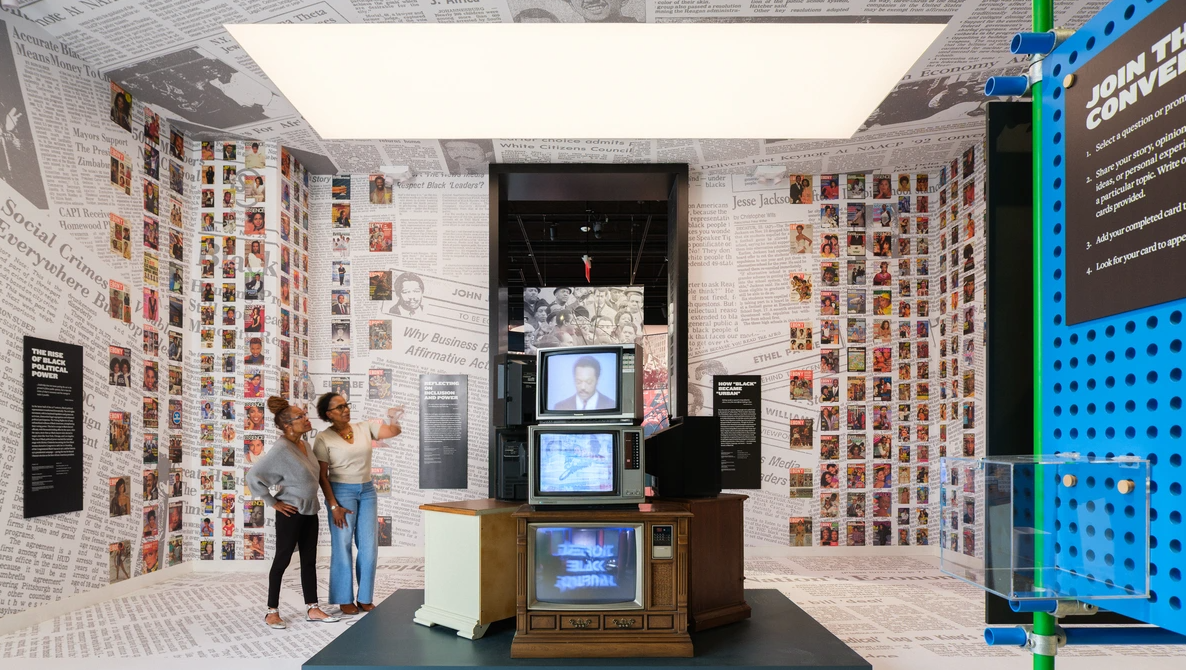
Moving through the gallery doors transports visitors into “Moving History Forward,” a robust exhibition—and the museum's tagline— that sets the tone for the entire experience. In this room, guests can learn about Maroon communities, the Underground Railroad, the development of free Black settlements in the North, and the massive northbound exodus. There is an enormous digital map outlining “Routes and Communities of Resistance” throughout the Americas and the Caribbean, artifacts like sketches of the Amistad “rebels,” and copies of “The Negro Motorist Green Book.” You can listen to firsthand accounts from those who traveled by train from the South to the North, or pull various maps detailing migration patterns. Historical timelines are literally written on the walls. One evocative piece of art, “Kontredans: Nou La/Counterdance: We Here,” uses cowrie shells, cotton, and archival indemnity records to address Haiti’s revolutionary history and its relationship to American identity. It is one of several artworks commissioned specifically for the museum.
Scott shared her intention that the museum’s design would cater to all types of learners, and it’s evident throughout the entire space. “We wanted to be a place where people can explore history, connect to the present, and leave feeling empowered to engage in their communities,” she said.
The UCRM is a multigenerational space for people of all ages. I can imagine elders sharing their firsthand experiences with their children and grandchildren. I envision young people answering the questions in the exhibit about their favorite banned book or noting a time they felt discriminated against in the “share your story” box. One of my favorite touches is the children’s books along the exhibition’s walls, specifically placed at eye level for kids so they can engage with the content too.
To read the full story, click here.